As humans, we emotionally connect with lived experiences in ways that just cannot be recreated by digital representations.
To quote the late great Robin Williams in my favorite movie, Goodwill Hunting, “So if I asked you about art, you could give me the skinny on every art book ever written… Michelangelo? You know a lot about him I bet. Life’s work, criticisms, political aspirations. But you couldn’t tell me what it smells like in the Sistine Chapel. You’ve never stood there and looked up at that beautiful ceiling”. I guess this is the long way of saying that you don’t truly understand something until you experience it in person, not just see it online. Today, I will be pondering the pros and cons of natural objects and their digital representations.
Do you ever take a picture of a beautiful sunset but include the tagline “the picture doesn’t do it justice” when you show it to other people? They see the same sunset you saw, so why doesn’t the picture capture the moment? Watching a video of the 9/11 terrorist attacks makes you feel sad. But that is nothing compared to the experience of seeing these attacks in person or, god forbid, being in one of the towers. Why do you feel differently when watching the same events through different mediums? Why do we travel to places that we have seen plenty of pictures of? My theory is that having an additional degree of separation from an object or idea’s natural form makes you view it in a less personal way. If you experience something, it becomes part of your reality; if you see something, it only becomes part of your memory.
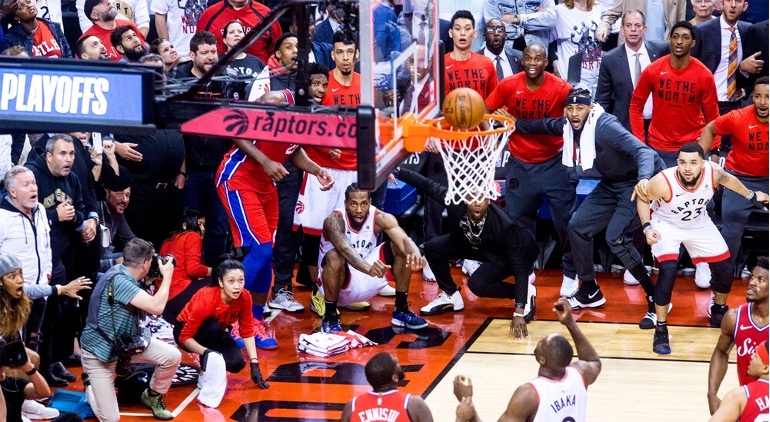
On the flip side, every once in a while, you see a photo that absolutely captivates you. We’re all familiar with the term “a picture is worth a thousand words”; there is something to be said about immortalizing a singular moment. I’ll include one of my favorite examples below. This picture might not mean much to you if you aren’t a basketball fan. But it doesn’t take a basketball fan to appreciate the range of emotions captured in one image. The picture is from game 7 of the 2019 Eastern Conference finals, and this shot is for the game. If it goes in, the Raptors go to the finals; if it bounces out, the 76rs advance. Crouching on the court with outstretched arms is Kawhi Leonard; standing next to him, intensely watching the ball bounce off the rim, is Joel Embiid; these are the two best players on the court and two of the best in the entire league. On the right side of the picture is 76rs forward Jimmy Butler, a fierce competitor and fan favorite. Although he is one of the best defenders in the league, all he can do now is watch and hope for the ball to bounce out. Kawhi has carried this Raptors team all game, accumulating 39 points, but none of that matters if this shot doesn’t go in. In the background, you can see the Raptors bench watching in anticipation; Danny Green and Jeremy Lin look like they’re trying to wish the ball into the hoop, rookie Jordan Lloyd is in a three-point-stance preparing to celebrate, Lorenzo Brown is holding his teammates back from prematurely storming the court. A fun exercise is to look at each fan in the crowd – everyone is watching the ball with some level of premature excitement or agony, all in total disbelief that the moment is happening. The fans in the arena are ready to explode if the shot drops or collectively mourn if it takes another bad bounce off the rim. They all want this shot to go in so badly but are absolutely powerless.
Digital images are powerful because they capture one singular moment, and we, as the audience, are bound to appreciate just that moment. You don’t need to know the outcome of the game to appreciate the photo of Kawhi and Embiid; you just have to be able to relate to that feeling of hope and uncertainty. Images remind the audience of times when outcomes were uncertain or when they so desperately wanted something to happen. And in doing so, the photos humanize these figures that fans view as superhumans in a way that the live experience could not do.
Being at the game in person would be a totally different experience than seeing this photo. Fans who were at the game remember Kawhi destroying the 76rs all game, they remember his teammates struggling to shoot the ball all game, they will recall how Embiid was playing a horrible game, and then, of course, the shot bouncing off the rim three times and falling into the basket. Of course they remember one of the most famous shots of all time, but they will also recall much more about this game than someone who just saw the highlight online or has only seen this photo.
Moments, objects, and ideas can be appreciated more fully in their natural state, but digital representations allow certain aspects to be appreciated at a deeper level.